
Ask a sixteen-year-old about a social media ban, and you get an answer sharper than most adults arguing about bans. She says, “It doesn’t prepare us for the real world when we will have to deal with these distractions in our life”. The teenager’s response strikes at the core of the ban vs

How I got hooked on chasing solar eclipses Traveling the globe for celestial events may seem downright loony—until you get a taste of the addictive world of ‘eclipse chasing’ Published on: Aug 23, 2026, 18:30:10 IST WSJ Prefer HTon Google Share via Copy link ‘It was glorious

Made-in-India semiconductor chips are now powering key Indian space missions. These domestically manufactured components support lunar and solar exploration efforts. Specialized chips from Mohali's Semiconductor Laboratory are used in Chandrayaan-3 and Aditya-L1

India's space program began with a small rocket range in 1962. It progressed to launching its first satellite and developing indigenous launch vehicles. Chandrayaan-3's lunar landing marked a significant achievement for the nation. The program now includes private sector involvement and ambitious

India plans to establish its own space station by the year 2035. The first module for the Bharatiya Antariksha Station has already received approval. This ambitious project aligns with the nation's growing space capabilities and aspirations. National Space Day celebrates India's achievements and
ISRO’s Bahubali gives India’s space story new muscle
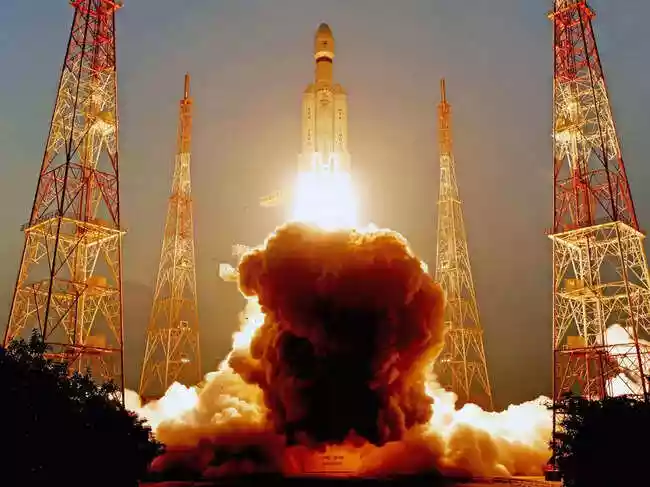
India's space ambitions have dramatically expanded, from early bicycle-carried rockets to launching its heaviest satellite with the LVM3-M5. This evolution showcases a nation's journey towards self-reliance, with ambitious plans for a space station, lunar missions, and a growing private sector, all aiming for global leadership by 2047.
As ISRO's heaviest launch marks a new chapter, India's celestial ambitions are expanding from Sriharikota to the Moon and the Sun and beyond.
You've probably seen that photograph, the one from the 1960s showing Indian scientists carrying a rocket nose cone on a bicycle.
At first glance, it looks almost surreal, even quaint. But look closer, and you'll see something far more powerful: a country that refused to let limited means clip its ambitions.
Captured by the legendary Henri Cartier-Bresson at Thumba in Kerala, in 1966, the image isn't just a relic. It's the heartbeat of India's space story, a reminder that it began with grit, imagination and audacity.The man holding the rocket component is believed to be instrument maker Velappan Nair, with engineer C.R. Sathya beside him -- part of a small team that quietly scripted one of India's greatest scientific transformations.
As ISRO Chairman V. Narayanan put it, “The first milestone came on November 21, 1963, when India launched its first sounding rocket from Thumba near Thiruvananthapuram. From those humble beginnings, India has made tremendous progress.”
This was when India launched its first sounding rocket, NASA's Nike Apache, from that same location. The 715-kg rocket carried a 30-kg payload to an altitude of 207 km, modest by global standards, but monumental for a young nation finding its scientific footing.
In those few minutes, India went from aspiring to participating in the space age. And while the famous bicycle photograph is often linked to a later Centaure rocket, it embodies the same spirit: make do, make progress, make history.
Every Chandrayaan and Aditya mission traces its lineage back to that black-and-white scene -- a handful of scientists, a bicycle, a dream, and the quiet certainty that the sky was never the limit.
Fast forward to today. When the LVM3-M5, better known as Bahubali, thundered off Sriharikota's coast on Sunday evening, it wasn't just another launch lighting up the night sky. It was a statement of strength, confidence, and how far India's space story has come.
ISRO once again showed that New Delhi no longer needs to lean on anyone for heavy-lift missions. Standing 43.5 metres tall, the rocket carried the nation's heaviest communication satellite, CMS-03, into orbit, a major stride in both scale and precision.
Weighing 4,410 kilograms, CMS-03 is the most massive payload ever launched from Indian soil into a Geosynchronous Transfer Orbit. It will strengthen India's communication network across the mainland and seas, boosting everything from civilian telecom to strategic connectivity.
For ISRO, it marks India's entry into the league of nations capable of placing large, complex satellites in orbit independently. For the world, it's a reminder that India's space ambitions aren't just about affordability but also about capability, consistency and scale.
The Launch Vehicle Mark 3 (LVM3) is no rookie. This was its fifth operational flight, powered by solid strap-on boosters, a liquid core and an advanced cryogenic upper stage. Once called the GSLV Mark-III, the rocket's transformation into the LVM3 mirrors ISRO's own evolution: from dependent beginnings to decisive self-reliance.
Also Read: LVM3-M5 launch: ISRO shoots off India's heaviest communication satellite on ‘Bahubali'
The era of momentum
That soft landing near the Moon's south pole in 2023 wasn't just a technical triumph; it was a statement. India became the first country to touch down in that uncharted region, proving that precision and ingenuity can rival any global power's might.From there, the momentum didn't slow -- it accelerated. Aditya-L1 took off soon after, India's first solar observatory cruising 1.5 million kilometres away to the Sun–Earth L1 point, quietly watching solar storms and radiation patterns that shape life back home. Then came XPoSat, peering deep into cosmic mysteries through X-ray polarisation -- a domain previously owned only by the United States.
But the real story isn't in the list of missions; it's in what they signify. The Test Vehicle Abort Demonstration (TV-D1) in 2024 proved India's astronauts will have one of the safest rides to space when Gaganyaan finally lifts off. And NISAR -- the joint NASA–ISRO radar satellite launched in 2025 -- reflected a mature partnership between equals, mapping Earth's ice and terrain with extraordinary detail.
That same year, ISRO pulled off a feat long reserved for the big players -- an in-orbit docking through SpaDeX. The success means India is now building the muscle for orbital refuelling and space station maintenance, stepping closer to a permanent human presence in space.
Under V. Narayanan's watch, 2025 became a year of records -- over 200 notable achievements, from releasing 15 terabytes of solar data from Aditya-L1 to demonstrating in-space power transfer between docked satellites.
What this really means is simple: India's scientists are no longer running to catch up. They're setting the pace. And if the last few years are any indication, the world will be watching India not just for its rockets -- but for its rhythm.
Roadmap to 2047
The government's Space Vision 2047 reflects an ambition aligned with the idea of Viksit Bharat -- a developed India by the centenary of independence. It lays out a plan not just for more missions, but for an entire space ecosystem that sustains innovation, industry and human presence in orbit.Key projects in this roadmap reveal the scale of aspiration.
The Gaganyaan programme is set to conduct its first uncrewed flight by the end of 2025, followed by a crewed mission in 2027 that will carry Indian astronauts into Low Earth Orbit. By 2028, the first module of the Bharatiya Antariksh Station (BAS) -- India's own space station -- will take shape, with full completion targeted by 2035.
Chandrayaan-4, now under design, will aim for a lunar sample return, while a Venus Orbiter Mission in 2028 will probe the planet's scorching surface and dense atmosphere.
A new Next Generation Launch Vehicle (NGLV) -- reusable and cost-efficient -- is in development, expected to debut by 2032. And looking even further ahead, India has set its sights on placing a human on the Moon by 2040.
This steady escalation of capability signals that India no longer views space as an arena for symbolic achievement but as a pillar of national development and strategic autonomy.
Also Read: ISRO flexes its cosmic muscles as Bahubali launches heaviest comsat— a look at India's glorious chapters among the stars
Private sector lift-off
Here's where the story gets even more interesting. Alongside ISRO's scientific wins, a parallel revolution is reshaping India's space economy, this time powered by private enterprise.The 2023 Indian Space Policy and the creation of IN-SPACe changed everything, throwing open the gates for startups and private firms to build, test, and launch.
More than 300 companies -- from rocket makers like Skyroot and Agnikul to satellite innovators like Pixxel -- are now carving out their place in orbit.
ISRO, to its credit, isn't standing apart. It's actively mentoring young firms and giving them access to its testing and launch facilities.
“We are hand-holding private players at every stage from development to testing. It is the responsibility of the Department of Space to enable the growth of the space ecosystem in India,” ISRO Chairman V. Narayanan said recently.
His point was clear: “When the private sector does well and when startups grow, the common man of this country benefits in a very big way.”
To meet rising demand, ISRO is scaling up too, building a third launch pad at Sriharikota with a Rs 400-crore investment and a brand-new spaceport at Kulasekarapattinam in Tamil Nadu for smaller satellite missions.
The target? Fifty launches a year by 2029, up from fewer than ten today.
India's space economy set for five-fold growth
That ambition fits with a projection from the Confederation of Indian Industry (CII) and KPMG -- that India's space sector could grow fivefold by 2033, reaching $44 billion. The focus, the report says, is shifting from rockets and satellites to monetising downstream services like satellite communication (SatCom), navigation (NavIC) and Earth observation (EO).These applications are already woven into daily life, from precision farming and telecom networks to weather prediction and disaster response. “The decisive lever of growth lies in translating space infrastructure into mission-grade services,” the report notes.
Satellites like Cartosat and RISAT are no longer just tools for scientists, they're part of India's governance toolkit. Their Earth observation data now guide everything from urban planning to disaster response.
Meanwhile, the NavIC navigation network and GSAT communication satellites keep the country connected, secure and precise in everything from logistics to defence.
The real breakthrough, as the report points out, isn't in the hardware but in how it's used.
“The decisive lever of growth lies in translating space infrastructure into mission-grade services,” it notes, turning orbital assets into everyday solutions that strengthen national resilience.
As CII's Mallavarapu Apparao summed it up, “India's space sector has evolved from a mission-led programme to an innovation-driven economy anchored in satellite-enabled services.”
As per the PIB, the government's goal is ambitious but grounded: lift India's share of the global space economy from 2 per cent to 8 per cent by 2033, in a market expected to hit $1.8 trillion by 2035.
What this really shows is that India's space journey isn't just about reaching for the stars anymore. It's about turning that reach into real-world impact, innovation, jobs and economic lift-off back on Earth.
Additionally, India's space assets are also central to its strategic posture. The country plans to deploy 52 dedicated satellites for intelligence, surveillance and reconnaissance (ISR), enhancing defence readiness and situational awareness, reported ET.
Space-based monitoring now underpins border management, disaster response and even precision agriculture.
This blend of civilian and defence capability, often termed dual use, is helping India translate its space strength into national resilience.
Balancing autonomy and alignment
In June 2023, India joined the US-led Artemis Accords, a framework that promotes cooperation in lunar exploration and cislunar governance. For India, it was a landmark shift, one that opened doors to advanced technologies, training opportunities and deeper engagement with global space networks, reported The Diplomat.Soon after, the Axiom-4 mission carried Indian astronaut Shubhanshu Shukla to the International Space Station, a symbolic prelude to Gaganyaan. Meanwhile, NISAR became the flagship Indo-US satellite mission, underscoring how scientific collaboration can dovetail with strategic alignment.
But the country didn't stop at alignment. It doubled down on autonomy. On National Space Day 2025, Prime Minister Narendra Modi unveiled a model of the Bharatiya Antariksh Station and declared, “The day is not far when India will have its own space station.”
The BAS represents more than national pride. It's strategic insurance, a guarantee that India will not have to depend entirely on the US-led Artemis Gateway or the China-Russia International Lunar Research Station (ILRS).
Much like the PSLV once liberated India from foreign launchers, BAS will ensure sovereign control over human spaceflight and research infrastructure.
Still, this autonomy comes with steep challenges. A space station could cost around $3 billion annually to maintain, almost twice ISRO's current budget, The Diplomat reported. Building life-support systems, EVA suits and deep-space habitation modules will test India's manufacturing ecosystem.
And heavy investment in BAS could squeeze funding for commercial and Earth-observation ventures.
Even so, India's leadership sees these as necessary growing pains, the price of building lasting independence in space. But as the nation reaches higher, another challenge is quietly emerging back on Earth.
Private funding for India's space startups fell 55 per cent in 2024, according to Tracxn. The dip is more than a statistic; it's a warning light. Ambition alone can't sustain lift-off -- it needs steady capital, consistent policy and an appetite for risk.
The infrastructure is growing, the intent is clear, but the ecosystem still needs deeper roots to match its aspirations.
From its humble launch in 1963 to Bahubali's ascent in 2025, India's space story has always reflected its national spirit -- patient, determined and self-built. The next chapter for the country's spacefarers won't unfold low key in the shadow of others. It will unfold in high orbits under India's own flag.
Add as a Reliable and Trusted News Source Add Now!
Source: EconomicTimes
Related Posts: bahubali rocket,isro launch,india space story,lvm3 m5,cms-03 satellite,indian space research organisation,sriharikota launch,heavy-lift rocket,india space mission 2025

India observed its third National Space Day, commemorating the Chandrayaan-3 lunar landing. ISRO Chairman Dr. V. Narayanan recalled the agency's humble beginnings and current global standing. He highlighted Chandrayaan-3's soft landing near the Moon's south pole in August 2023
1 days ago

The Indian government created the Indian Institutes of Science Education and Research (IISERs) to offer students an intellectually vibrant research environment and to bring them into research at a relatively — vis-à-vis the Indian milieu — early stage
1 days ago

Prime Minister Narendra Modi aims to lure global expertise to India's expanding space landscape. He identifies the private sector's potential as a crucial asset for global competition. Key advantages include India’s affordability and its appetite for innovation
1 days ago

The Northeast India Space Workshop 2026 will convene in Guwahati to explore regional transformation. This event aims to leverage space technology for global reach and economic growth. Stakeholders will discuss Northeast India becoming a developer and testbed for space solutions
1 days ago

The dramatic 1° Celsius rise in global temperatures since industrialisation has already proved to have upended the lives of wild flora and fauna: that of at least 15,801 species on the Red List of Threatened Species, according to IUCN (International Union for Conservation of Nature)
2 days ago

India faces a substantial cost gap with the United States for launching payloads. A recent study estimates India's cost at over $13,000 per kilogram by 2025. This contrasts with the United States' estimated cost of $3,225 per kilogram. The study highlights scale and experience as key factors for
2 days ago

Prime Minister Narendra Modi encouraged young space entrepreneurs to innovate for agriculture and daily life. He highlighted the potential of India's private space sector for global impact. Startups were urged to engage with schools and inspire future generations
2 days ago

Rock-solid evidence for the origins of birds Stones in dinosaur stomachs may help understanding of avian evolution Published on: Aug 20, 2026, 21:09:09 IST The Economist Prefer HTon Google Share via Copy link How do you know what a dinosaur ate? Guts rot away after death
3 days ago

Was it meat or glucose that fueled the growth of the human brain? If evolutionary science told us, hitherto, that human brain expansion relied on meat to grow, a new study has an interesting addition to this theory. Published in a recent issue of Science
4 days ago

The Indian Space Research Organisation (ISRO) is set to launch the GISAT-1A satellite in September, in a mission that will be watched closely for many important reasons. Since the two successive PSLV mission failures, in 2025 and early 2026, ISRO had paused launches as it investigated the reason
4 days ago

The Hara forests are a vital ecological treasure of the Persian Gulf. Spanning the Strait of Hormuz, these mangrove forests consist mainly of grey mangrove trees (Avicennia marina), which have a special filtration system in their roots that allows them to thrive in saline conditions
5 days ago

India spends more to put a kilogram of payload into orbit than any other major spacefaring nation, marring its public image as a cost-effective launcher, according to a new peer-reviewed analysis of more than six decades of rocket launches published in Economics Letters
7 days ago

“The past is a foreign country; they do things differently there,” the English novelist L.P. Hartley wrote famously in his 1953 novel The Go-Between. In a peculiar twist, the same cannot be said of the Moon. It is not a foreign country, or even a foreign world: the U.S
7 days ago

The computer did not create a virus. It did not touch a test tube or handle a living cell. What it did may ultimately be more consequential: it helped decide what the virus’s genome should be. Researchers at Stanford University and the Arc Institute used artificial intelligence (AI) to design
8 days ago

Spectators across Spain watched in wonder, some whipping off their protective glasses and rising to their feet in unison, as a rare total solar eclipse swept across the north of the country on Wednesday (August 12, 2026) evening, plunging it into darkness
8 days ago

Japan's MMX mission will blast off soon to collect Martian moon samples. The spacecraft will orbit Mars for three years and land on Phobos. This mission aims to understand Solar System origins and life's emergence. A rival Chinese mission also plans to return Mars samples around 2031
8 days ago

Draft rules for the SHANTI Act, 2025, mandate financial security for nuclear damage. Operators must maintain insurance or financial security until spent fuel removal. Foreign reactor designs require certification by their country of origin's regulatory body
9 days ago

As a total solar eclipse will be visible in parts of Europe on August 12 for the first time since 1999, solar physicists at the Raman Research Institute (RRI) in Bengaluru, along with collaborators, have predicted the magnetic structure of the Sun’s outer atmosphere, or its ‘crown’
9 days ago

When a young man was brought to my clinic after his first episode of psychosis, his parents wanted to know when he could return to college. This is not an atypical first interaction. However, in many instances, after a few consultations later and especially once the immediate crisis had settled
11 days ago

Some people can live apparently ordinary lives even when both copies of a gene (one inherited from the mother and the other from the father) have stopped working. Until their DNA is sequenced, they may never know that this has happened. A large study from Pakistan, published in Nature (June 2026)
11 days ago

Physicist Deepak Dhar received the 2026 Dirac Medal for his statistical mechanics work. He shares the award with three other scientists for their complex systems research. Their contributions span biology, finance, computer science, and artificial intelligence
12 days ago

Colombia and Venezuela experienced deadly earthquakes due to tectonic plate friction. The Nazca plate sliding beneath the South American plate caused tremors. Earthquake magnitude and depth significantly influenced the destructive impact. Building codes and terrain also played crucial roles in the
12 days ago
India has been invited to join NASA's Moon Base program. Discussions focused on expanding civil and commercial space cooperation. Both nations agreed to advance open scientific data sharing under Artemis Accords. They also reaffirmed commitment to UN guidelines for outer space sustainability
12 days ago

A team led by researchers at the Johns Hopkins School of Medicine has found that several inherited traits in the mouse genome break the rules Gregor Mendel laid down in the 19th century about how genes work. This is not because the genes mutate but because of chemical modifications of the genome
13 days ago

Urban India’s water emergency will not be fixed by better crisis management alone. Over the coming decades, hundreds of millions more people will live and work in Indian cities, driving a sharp increase in the urban water demand. And unless we change how we design, finance
15 days ago

IN-SPACe seeks private partners to manage ISRO's new launch complex. This facility will support small rocket launches and enhance launch efficiency. Private entities will handle end-to-end operations and maintenance of the complex. ISRO will provide initial technical and operational support for
15 days ago

NASA astronauts Anil Menon and Jessica Meir on Friday (August 6, 2026) concluded their spacewalk outside the International Space Station to assemble the modification kit for its power channel that would allow addition of solar arrays. The spacewalk – 281st in support of the space station –
15 days ago


