
Bolivian riot police clashed with anti-government protesters in La Paz on Friday (May 22, 2026) for the second time in a week as unions and Indigenous groups pressed their calls for President Rodrigo Paz to step down. Demands for the business-friendly conservative to resign have persisted despite

A fire broke out at an oil depot in the southern Russian port of Novorossiysk following a Ukrainian drone attack, the city's mayor said on Saturday (May 23, 2026). "As a result of falling UAV (unmanned aerial vehicle) debris, a fire broke out at the oil depot

A newt dawn: Wknd talks to Whitley awardee Barkha Subba about her fight for salamandersThey walked among the dinosaurs. Now, they are in danger. There may be only 5,000 Himalayan salamanders left in the wild in India, Subba says. Published on: May 23

Indian woman praises China’s cleanliness, questions civic sense in India: ‘You won’t find a single wrapper’An Indian woman said China’s cleanliness proved civic sense mattered more than population. Published on: May 23, 2026 2:03 PM IST By Mahipal Singh Chouhan Share via Copy link An

Nita Ambani left in splits as student slips Mumbai Indians joke into DAIS graduation speechA Mumbai Indians joke cracked by the head boy of the DAIS' 2026 graduating class left the entire auditorium, including Nita Ambani, laughing. Published on: May 23
India Is Splitting Apart Beneath Tibet, Scientists Warn Of Deep Cracks
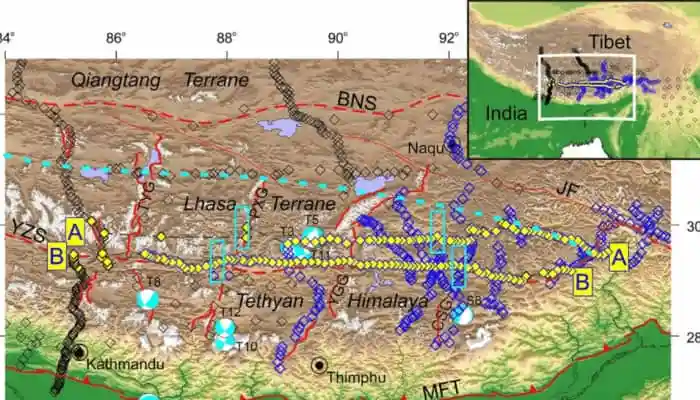
Indian Tectonic Plate Is Splitting Apart Beneath Tibet, Scientists Warn Of Deep Cracks And Future Earthquake Risks
New seismic data reveals that the Indian tectonic plate is breaking apart deep beneath Tibet, in a phenomenon scientists call “delamination.” This groundbreaking discovery not only redefines how the Himalayas formed but also raises concerns about potential seismic instability in the region.
Geologists have made a startling discovery, the Indian tectonic plate is tearing apart beneath Tibet, unveiling a complex geological process that could reshape our understanding of how the Earth's crust evolves. The research, presented at the 2023 American Geophysical Union (AGU) conference, uses cutting-edge seismic data to show that India's plate isn't just sliding under Eurasia, it's splitting in two deep below the surface.
For decades, scientists have studied the collision between the Indian and Eurasian plates, the powerful force behind the formation of the Himalayas and the Tibetan Plateau. However, new findings suggest this collision is far more complex than previously believed.
Add Zee News as a Preferred Source
According to the seismic data, the Indian plate is undergoing “delamination,” a process in which its denser lower layer peels away and sinks into the Earth's mantle, while the lighter upper crust continues to move northward beneath Tibet. This split challenges traditional models of plate subduction and provides a new explanation for the region's unusual geological formations.
“We didn't know continents could behave this way, and that is, for solid Earth science, pretty fundamental,” said Douwe van Hinsbergen, a geodynamicist at Utrecht University.
The collision between the Indian and Eurasian plates began nearly 60 million years ago, thrusting massive slabs of land upward to form the world's tallest mountain range. But new data shows that this growth is still fueled by the Indian plate's internal fracture.
As the bottom portion of the Indian plate sinks, the upper crust continues to push forward, grinding and folding as it meets resistance from the Eurasian plate. This continuous movement creates deep cracks and seismic tension beneath Tibet, a reminder that the Himalayas are not just ancient relics, but living, shifting mountains still shaped by immense geological pressure.
The research team analysed seismic wave data from 94 observation stations across southern Tibet, revealing layers of distortion and fault lines extending tens of kilometers into the Earth. These fractures may explain why certain regions experience more frequent earthquakes and rapid uplift compared to others.
The key to this discovery lies in the use of advanced seismic imaging. Researchers studied both S-waves (vertical) and P-waves (horizontal) traveling through the Earth to map variations in density and movement. The combination of these wave readings allowed scientists to reconstruct a 3D model of the Indian plate's internal structure, revealing the split between its upper and lower sections.
This data offers more than just geological insight; it provides a powerful tool for earthquake forecasting. Understanding how the Indian plate is deforming helps identify pressure zones that could trigger major seismic events in the future.
The finding that the Indian plate is splitting beneath Tibet has profound implications. Not only does it reshape long-held geological theories, but it also underscores the seismic risks facing the Himalayan region. Scientists believe that as the lower part of the plate continues to sink, stress will build up along fault lines, potentially setting the stage for future large-scale earthquakes.
Moreover, this discovery opens the door for comparative studies in other tectonic zones around the world. Similar delamination processes might be occurring beneath regions such as the Andes or Rocky Mountains, where plates collide and deform in complex ways.
As researchers continue to monitor these deep cracks beneath Tibet, one thing is clear: the Earth beneath our feet is far from stable, it's a restless, living planet constantly reshaping itself in ways we are only beginning to understand.
1. What does it mean that the Indian plate is splitting?
It means the lower, denser part of the plate is separating and sinking into the mantle while the upper crust continues moving beneath Tibet.
2. How was this discovered?
Scientists analyzed seismic wave data from 94 observation stations across southern Tibet, revealing deep structural changes beneath the surface.
3. Why is this significant?
It redefines existing models of plate tectonics and helps explain the ongoing uplift and seismic activity in the Himalayan region.
4. Could this lead to more earthquakes?
Yes, the stresses caused by this splitting may contribute to future seismic activity in northern India and Tibet.
5. What happens next?
Researchers plan to expand seismic monitoring to understand how delamination progresses and whether similar processes occur elsewhere on Earth.
(Pic Credits: PNAS, Wikipedia)
Source: ZeeNews
Related Posts: England at crossroads as seismic India semi-final looms Nestle's new CEO faces full plate of problems Finn Allen's record-breaking century earns New Zealand big win over South Africa in T20 World Cup semis This disturbing new dating trend is breaking hearts and is far more toxic than you might think New iOS 26 glitch is breaking photos shared from Android phones Protein, Gut Health And The Indian Plate Cardiologist with 26 years of experience says ‘perfect Indian plate’ looks like… How The Indian Plate Collision Makes Afghanistan A Nutritionist Rashi Chowdhary Explains Why Indian Women Are Breaking Up With Diet Culture Why India Is Rethinking What Goes On The Plate

Rajya Sabha MP Raghav Chadha, who switched from the AAP to the BJP recently, has been appointed as the new chairman of the Committee on Petitions of the Upper House. After reconstituting the Committee on Petitions, Rajya Sabha chairman C.P. Radhakrishnan nominated 10 members of the house to the
1 hours ago

Mumbai, India’s gold demand is expected to contract by 50-60 tonnes this calendar year, around 10 per cent lower than the previous year, following the import duty hike, according to the World Gold Council (WGC). “Looking at 2026 as a whole, we estimate that combined jewellery and bar and coin
1 hours ago

India has issued a heightened health advisory for travellers arriving from several African nations after a fresh Ebola outbreak triggered global concern and prompted stricter surveillance measures worldwide. In response to a fresh Ebola outbreak in the Democratic Republic of Congo
1 hours ago

Elon Musk is going all-in on an unproven technologyWhat lies behind the world’s biggest public offering Published on: May 23, 2026 2:24 PM IST The Economist Share via Copy link IT IS A launch of a more bureaucratic sort than normal for SpaceX, but still characteristically spectacular. On May 20th
1 hours ago

Fisherman M Yuvaraj bustles about his fibreboat, filling fuel in the engine, and checking if everything is in order. He even throws in an umbrella in case it rains. It is almost 4pm when he pushes his boat close to the bank of Pulicat lake. The 57-year-old is not setting out on a fishing trip
1 hours ago

Kerala HM announces 'Operation Toofan' anti-narcotics campaignKerala HM announces 'Operation Toofan' anti-narcotics campaign Published on: May 23, 2026 2:24 PM IST PTI Share via Copy link Thiruvananthapuram, Kerala Home Minister Ramesh Chennithala on Saturday announced a comprehensive statewide
1 hours ago

Mamata’s Lakshmir Bhandar gave Bengal women Rs 1,000 to Rs 1,700 a month based on category. Adhikari’s Annapurna Yojana scraps the categories and doubles it to a flat Rs 3,000. Bengal has a new scheme that is putting real money directly into women’s hands every month — and it is bigger than
1 hours ago

Leadership in Civil Engineering and Construction Management is not born in air-conditioned classrooms. It is shaped under the open sky, amid dust, deadlines, drawings, and decisions. For students aspiring to become civil engineers and construction managers
1 hours ago

French Open crisis deepens as top stars limit media duties in coordinated protest over revenue splitWomen's singles defending champion Coco Gauff answered only 10 questions in her pre-tournament press conference. Published on: May 23, 2026 2:32 PM IST Written by Neelav Chakravarti Share via Copy
1 hours ago

Chopper crash near Leh: Injured major general poses, pilot flashes 'victory' sign in viral selfieAn Army Cheetah chopper crashed near Leh in eastern Ladakh last week. An image from the crash site is now viral. Updated on: May 23, 2026 2:36 PM IST By Rahul Singh Share via Copy link Three days after
1 hours ago

Kolkata Knight Riders and Delhi Capitals face off in a crucial IPL clash, with playoff hopes hanging by a thread. Both teams need a win, but their fate also depends on other results. KKR's strong recovery contrasts with DC's reliance on KL Rahul
1 hours ago

Some of the most useful lessons I learnt as a young restaurateur came from New York restaurateur Danny Meyer’s book Setting the Table. He writes beautifully about the guest who comes in alone. Most diners come in with an agenda — to impress a date, close a deal
1 hours ago

The Union government told the Supreme Court on Friday that 217 Indian nationals had joined the Russian military during the war in Ukraine, of whom 139 have been released from their contractual agreements, The Hindu reported. Additional Solicitor General Aishwarya Bhati told a bench headed by Chief
1 hours ago

Hamza Burhan, a key operative linked to the Pakistan-backed terror outfit Al-Badr, who also worked as an Over Ground Worker (OGW) during the Pulwama terror attack period, was killed in Pakistan-occupied Kashmir (PoK) on Thursday. Several wanted Pakistan-based terrorists
1 hours ago

Nothing says summer quite like a chilled, fruity mocktail. As temperatures continue to rise, refreshing drinks packed with tropical flavours, citrusy notes, and vibrant ingredients are becoming the perfect way to cool down. Whether you are hosting a weekend brunch, planning a house party
1 hours ago

Producer Vashu Bhagnani has lashed out at David Dhawan and his actor-son Varun Dhawan. On Friday, Vashu held a press conference in Mumbai and claimed that the storyline of Hai Jawani Toh Ishq Hona Hai is similar to Biwi No.1. Released in 1999
1 hours ago

Hyderabad, May 23 (PTI) A lawyer died after being hit by a car outside his residence here in a suspected case of pre-planned murder, police said on Saturday. The 63-year-old victim was about to get into his car when the car hit him at his residence at Masab Tank here.Hyderabad
1 hours ago
Raghav Chadha has been appointed the new chairman of the Committee on Petitions in the Rajya Sabha. The Rajya Sabha chairman reconstituted the committee and nominated ten members. This appointment takes effect from May 20, 2026. Dr. Menaka Guruswamy has also been nominated to the Joint Committee on
1 hours ago

Formula 1’s silly season has arrived early, and we have Red Bull Racing boss Laurent Mekies to thank for it. The Frenchman doubled down on his explosive claim that Max Verstappen’s long-time race engineer, Gianpiero Lambiase, is heading to McLaren to eventually become team principal
1 hours ago

The blue-collar town that’s set to decide Britain’s next Prime MinisterLabour left-winger Andy Burnham wants to replace Keir Starmer as prime minister. First, he must convince the Makerfield voters and fend off Reform UK. Published on: May 23
1 hours ago

Human beings are not just shaped by their actions, but they are also creatures of circumstance. This is especially true in the sporting world, where athletes’ performance not only depends on their quality but also on who the rivals are, their prevailing standards of excellence and the setting in
1 hours ago

Do you have greasy flakes on nose and scalp? Dermatologist explains what you are doing wrongSeborrheic dermatitis is a chronic skin condition that manifests in the form of greasy flakes on the nose and scalp. Dr Abigail Waldman shares what to do. Updated on: May 23
1 hours ago

Investors just can’t get enough of stocks these daysWar, inflation and worries about the AI boom haven’t kept stocks from setting records. Published on: May 23, 2026 2:27 PM IST WSJ Share via Copy link Investors just can’t get enough of stocks these days
1 hours ago

Fuel prices have surged for the third time in eight days. Congress leader Mallikarjun Kharge criticizes the government, accusing it of "looting" citizens. He highlights international examples where countries provided relief. India's petrol and diesel prices have increased by nearly Rs 5 per litre
1 hours ago

Ballia (UP), May 23 (PTI) A court here has sentenced a man to life imprisonment for murdering his wife and dumping her body in a pond in 2019 after the couple remained childless, police said on Saturday. According to the prosecution, Nepal Paswan
1 hours ago

Editorial independence is core to our work. Some links may earn us a commission, without influencing our opinions.Sharara sets are the ultimate festive trend for Eid al-Adha: Choose from these picks under ₹3000From pastel embroidered sets to regal Banarasi shararas
4 hours ago

Tulsi Gabbard resigned as President Donald Trump’s director of national intelligence on Friday (May 22, 2026), saying she needed to step away as her husband battles cancer. She is the fourth Cabinet official to depart during Mr. Trump’s second term. In her resignation letter
4 hours ago


