
The Delhi High Court has stayed proceedings in a criminal defamation case filed against Sudarshan TV and its editor Suresh Chavhanke in connection with allegations that his channel made false accusations against a madrasa. The case against Chavhanke was filed by Mohammed Tufail Khan

China said on Sunday (August 23, 2026) it was postponing its planned ambitious Chang'e-7 lunar mission, which was set to carry out explorations including searching for water ice on the moon. The Chang'e-7 spacecraft was originally set to lift off in the coming days from the Wenchang Space Launch

Canada’s Carney Puts His ‘No Deal Is Better Than a Bad Deal’ Doctrine to the Test The prime minister ’s approach has broad support from the Canadian public and his political opponents, but it isn’t without risks. Published on: Aug 24, 2026, 14:05:27 IST WSJ Prefer HTon Google Share via

A group of former cricket captains, including Indian batting legend Sunil Gavaskar and one of England's longest-serving skippers Sir Alastair Cook, have called on Pakistan to ensure its ex-PM Imran Khan be given proper care while in custody. The cricketer-turned-politician has been in jail since

Fewer than 20 commodity vessels transited the Strait of Hormuz at the weekend, shipping data showed on Monday (August 24, 2026), as Iranian and U.S. blockades restrict traffic through the chokepoint for energy shipments. Four vessels crossed the strait on Sunday (August 23, 2026)
Why Adivasis displaced by India’s first thermal power plant still depend on stolen electricity
Jagdish Hansda has faint memories of the village where he grew up.
“Back then, there used to be nothing here except us Adivasis, our fields, jungles and wildlife,” said Hansda, who is now in his late seventies. The village, Jhinjirguttu, was in what was then Bihar, and now falls within Jharkhand. “Some Mulvasi communities also used to live among us,” Hansda added, referring to lower caste communities native to the region.
The village of Hansda’s childhood does not exist today because in the late 1950s, the Bihar government displaced its residents to set up the Chandrapura Thermal Power Station, now situated in Jharkhand’s Bokaro district. The power station is spread over 1,800 acres of land in Chandrapura, of which around 1,200 acres was acquired from locals.
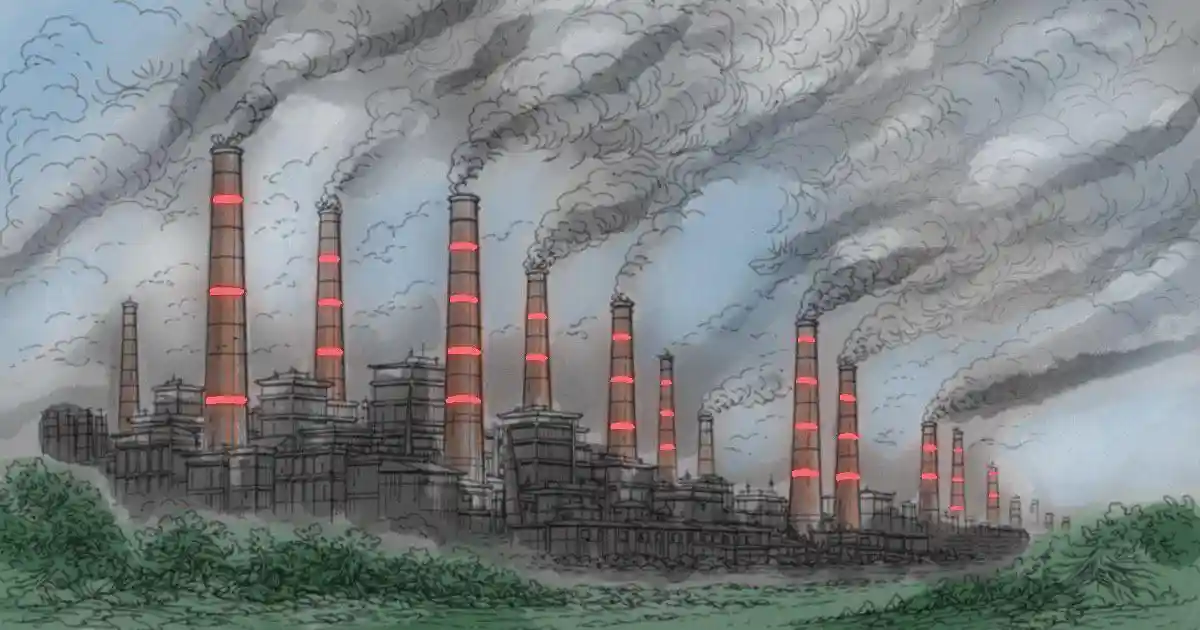
On the evening of December 13, I met Jagdish and his peers at a tea stall in Chandrapura town. A thin smog hung around us as we sipped our tea. In the backdrop, a red-and-white chimney of the Chandrapura Thermal Power Station loomed over us, intermittently blinking red lights in the dark.
He recounted that the villagers would say, “Sarkar aa rahi hai” – the government is coming. “Eventually when the plant came, we all got scattered here and there,” he said.
Today, Hansda lives in an informal settlement that bears the same name as his original home, and where many other displaced families were also resettled. But unlike the idyllic village surrounded with lush green fields that he remembers, present day Jhinjirguttu is a small settlement of makeshift houses covered in fly ash.
Stories like Hansda’s are common across Bokaro. The construction of the Chandrapura plant began in 1959, and by 1964 two of its units were operational. It was the first major coal-fired thermal power plant built in independent India, and was constructed by the Damodar Valley Corporation, or DVC – a multi-purpose river valley project established by the Indian government in 1948.
Now, according to its 2024-’25 annual report, the corporation has a total of six thermal plants, three hydel stations and multiple solar power projects, which have a combined capacity of 6,715 MW. It provides power to eight states. In the same year, it also provided 844.56 million gallons of water per day to domestic and industrial users in Jharkhand and West Bengal.
In his doctoral research on the corporation, published in 1969, the social scientist TN Bhalla noted that it rehabilitated people under the Land Acquisition Act of 1894. Under the act, people who gave up land for a project could either opt to receive cash compensation, or another patch of land, along with a new house if they lost a house in the acquisition process. However, owing to budgetary constraints, the company could only offer the displaced people wasteland, or land that was far from their villages. Bhalla noted that in order to ensure that the acquisition process went ahead smoothly, the company encouraged people to opt for cash compensation instead of land.
This is reflected in a company report published in 1966, which states that none of the displaced families of Chandrapura “asked for land for land or house for house”, and that they were thus all compensated in cash.
The accounts of Hansda and others in Chandrapura suggest that this process was far from fair.
Hansda noted that Adivasis who were displaced were not asked for informed consent, which would have entailed allowing them to first consider various options and weigh their risks. “Our ancestors were poor and unlettered, the DVC officials did not explain the consequences of what was going to happen,” Hansda said. “They were just given cash, and that too a small sum which was not enough to go buy land elsewhere.”
In many instances, he noted, the money was transferred from the company to the state government treasury, but not further to the displaced people. “My own grandfather told us that the money was with the treasury and that we should try to obtain the money in the future,” he said. “But my parents didn’t know how to get it and time just went by.”
By 2017, the first set of thermal power units that were set up in the 1960s were retired. In February 2025, the corporation announced that it would set up a new 1600-MW supercritical thermal power plant in collaboration with Coal India in Chandrapura. “The third set of power plants are going to be built,” said social worker Arshal Marandi, whose grandparents were displaced for the plant in the 1960s. “But we, the Adivasis who were originally displaced for CTPS, have still not received what we are owed.”
The Damodar Valley Corporation is a government corporation that was founded in 1948, under the aegis of the ministry of power. In setting it up, Indian leaders drew inspiration from the Tennessee Valley Authority in the United States, which aimed to reduce floods in the Tennessee river valley, as well as generate power for the country.
The company’s dams and plants were some of the largest projects that the government championed in independent India. Jawaharlal Nehru called them “temples of modern India” that were essential for national development after Independence. Such projects, he said, would help “lead the country forward”, as well as “make it strong” and “remove the poverty of its people”.
The corporation’s main objectives were to aid with controlling floods on the Damodar river, as well as to generate power for the country and provide water for irrigation in the Damodar valley region. These aims were enshrined in the Damodar Valley Corporation Act, 1948. The act also mentions other objectives, such as “the promotion of public health and the agricultural, industrial, economic and general well-being in the Damodar Valley and its area of operation”, and “the promotion of afforestation and control of soil erosion”.
At the outset itself, community leaders argued that it was imperative that the project benefit the Adivasi communities who would be most affected by it.
On February 14, 1948, the act was discussed in the Constituent Assembly debates. Speaking on behalf of the Adivasis who were to be displaced, Jaipal Singh Munda noted that the corporation’s projects were going to be “big and bold” and a “model for future river projects throughout India”. But, he argued, displaced Adivasis deserved more than just land and homes. “It is no good saying that we are going to give them better houses,” he said.
Decades later, most people Scroll spoke to on the ground noted that the communities had been excluded from and even oppressed by the project. In fact, the corporation has also been met with fierce resistance right from the early years of its functioning. Hansda explained that over the decades, people have protested several times against it, with demands such as for jobs, and basic facilities like roads, water and electricity.
In the mid-1970s, in response to this pressure, the company drew up a “displaced panel”: a list of 701 people who had been displaced by the construction of two dams and two power stations, and who would be entitled to employment with the company. But, according to government data, until the mid-1990s, only 64 people from that list had been provided employment.
In parallel, in 1992, a group of 91 people, 87 of whom were not on the list, and who had been displaced by multiple projects of the corporation, including the Chandrapura Thermal Power Station, approached the Kolkata High Court demanding jobs with the company. The Kolkata High Court ruled in favour of the displaced persons, but the company challenged this ruling in the Supreme Court.
The apex court dismissed the case in 1992, and ordered the company to provide employment for all petitioners.
In December 2011, in answer to a question in the Lok Sabha about updates in the matter, KC Venugopal, then the minister of state for power, stated that apart from the initial 64 who had been given jobs, after the 1992 Supreme Court judgement, the company had employed another 129. Further, he stated that another 44 on the list were “awaiting employment”, while 458 candidates had been paid a sum Rs 3 lakh in lieu of being given employment.
But activists argued that these officially recorded numbers were misleading. “There are many more people who were displaced and never received compensation or jobs,” social worker Narayan Marandi said. “But they were too poor to fight out their case in the courts.”
Scroll emailed the Damodar Valley Corporation, seeking responses to criticisms that it had not fulfilled its obligations to local communities. This story will be updated if the company responds.
Today, Adivasis around the Chandrapur plant continue to lead a tenuous existence decades after their ancestors were displaced for it.
Around seven Adivasi hamlets lie on the outskirts of Chandrapura town and the power station.
Speaking to Arshal, I learnt that residents of four – Bhursabaad, Neer Pipradi, Rajabera and Burudih – were displaced from their original homes but that most had land neighbouring their villages on which they were able to resettle.
But when I met leaders and others from TSC basti, Jharnadih and Jhinjirguttu hamlets, they told me that when their homes were taken over, they did not have nearby land on which to resettle, and so had to move to entirely new locations. None of the residents had any government documents that stated that the land on which they had been resettled belonged to them.
Locals noted that the displaced people live with this uncertainty despite the fact that official housing for staff of the plant is commonly used by non-employees who had bribed officials of the corporation.
The Chandrapura plant is surrounded by the DVC Colony, a vast complex of housing quarters for staff belonging to various grades. Built in the 1960s, several quarters have become dilapidated over the years and have even been marked with notices that deem them unfit for habitation. But despite this, employees have been living in them.
In other instances, employees or their families did not vacate the quarters after they retired from the corporation.
He added, “Others who moved in here run shops or drive rickshaws and do other jobs around the plant.”
The company did not respond to Scroll’s request for comments on these claims about the use of official housing.
Arshal noted that though many such families had managed to find housing in these official quarters, “hardly any displaced Adivasis have been able to get space” in them. As he explained, most Adivasi hamlets lie on marginal land right next to the quarters.
Secure housing appears out of reach for even prominent members of these villages, who hold administrative posts.
A few metres away to the south of the thermal power station, a wide road climbs a small hill. On the left are the company’s administrative quarters, a row of mustard yellow buildings in a passable condition, neatly lined with trees.
Towards the right on sloping land lies Jharnadih, a large informal settlement with some mud houses, and many others made of concrete. Both areas fall under the Rangamati south panchayat. On December 12, I walked up the road to meet the social worker Narayan Marandi, who is also the mukhiya of the panchayat. I stopped at a tea stall to enquire about his whereabouts.
“The mukhiya of this panchayat is Adivasi, so he lives further ahead on the right in the basti,” one person told me. When I reached Narayan’s house, I saw that he was carrying out some refurbishments in his home – a somewhat contradictory decision given that his claim on the land remains tenuous.
The problem is not only one of ownership of land – in recent years, villagers have even struggled to access entitlements under government schemes that are intended to help them build houses.
Narayan noted that until the 1980s, Jharnadih’s residents were able to avail of the Indira Awaas Yojana, which provided grants for the construction of houses. More recently, in 2020, however, when several villagers sought to apply for funds to build houses – this time under the state’s Abua Awaas Yojana – their applications were rejected. They were asked to submit no objection certificates from the Damodar Valley Corporation in order to avail of the scheme. “It is impossible to get NOCs from the DVC. We have tried approaching officials but they do not have time for us,” said Narayan.
The difficulty in procuring all kinds of documentation leaves most villagers gripped with anxiety.
Villagers from Jhinjirguttu hamlet, too, find themselves in a similar situation. Their village was completely displaced in 1959, and the current settlement stands on government land for which the villagers have no papers. “If our ancestors were given enough money to buy more land, wouldn’t they have bought this land to settle on?” said Sanjay Hembrom, a resident.
Residents of the Adivasi hamlets also struggle without basic civic amenities like water and electricity. “Even the electricity and water have to be stolen,” said social worker Shashikant Hembrom.
This is despite the fact that the Damodar Valley Corporation has since the 1980s been running a “social obligation programme”, which later dovetailed with its corporate social responsibility initiatives.
In its 2021-’22 corporate social responsibility report, the company stated that it works with 52 villages around the Chandrapur plant, including the Adivasi hamlets. Its objectives included “uplifting the socio-economic conditions of the communities residing within a radius of 10 km from the major projects of DVC” and “striving to improve the standard of living” of those affected by the project.
But their efforts, residents said, have been arbitrary and inconsistent. Shashikant noted that the corporation had taken some steps, such as installing streetlights in some villages and distributing school bags and sports equipment. While it “makes a big show” of this work “for CSR publicity”, he argued, “ it won’t spend the same money on providing us with basic amenities”.
Residents of Bhursabad, which the company adopted in the 1980s under its social obligation programme, said that they too have received few benefits from the programme. “All that we got out of it was a signboard, nothing else,” said Arshal. “I heard they made a pucca road back then, which hasn’t been repaired in forty years. All the roads here are terrible and they have been that way for years. It was only when I visited Ranchi for my bachelor’s that I got to see a fresh pucca road.”
After years of agitation by the villagers, Arshal recounted, the corporation installed a few public taps around five years ago – but, he noted, water is only supplied for a few hours every day, in a slow drip. Thus, most people use wells or go further outside the village to use hand pumps. “Just a few metres away lies the staff quarters which receive regular electricity and water supply, but they haven’t extended that service to us,” he said.
In Jharnadih, Ramesh Soren recalled that the corporation had put up electric poles in the settlement several years ago, but that it later disconnected the power supply. Since then, villagers have been compelled to steal electricity from nearby power lines.
Shashikant, a resident of Burudih, recalled that the corporation had installed a water tank with a tubewell some years ago, as part of its corporate social responsibility activities. But the tubewell had ceased to function in a few years, after which villagers were left to fend for themselves.
Arshal recently joined a local committee that works with the corporation’s corporate social responsibility wing for Chandrapura. “I am the first local Adivasi on that team,” he said. “In so many years, they had no Adivasi on board. Who was representing our needs?”
Sanjay Hembrom noted that even as Adivasi communities in the region struggle for their basic rights and entitlements, at the highest levels, the government had already begun the process of assessing the feasibility of moving away from dependence on coal energy and ensuring a “just transition” for those who depended on the sector.
In 2022, the Jharkhand government set up a Just Transition task force to assess local communities’ dependence on coal and draw up a plan for reducing it, and moving the state towards more sustainable fuels. In 2024, a group of researchers from the Centre of Financial Accountability, Delhi, conducted a study in Chandrapura, which aimed to assess strategies to reduce local communities’ dependence on coal, as well as on the plant as a source of a livelihood. The study is yet to be published.
On the ground, despite their decades of struggle and deprivation, many Adivasis in Chandrapura welcomed the upcoming thermal plant. “There is a saying here – as long as the plant remains, the people will survive,” said Sanjay Murmu, a resident of Jharnadih.
This was despite the fact that, as researchers observed, many Adivasis had never been properly absorbed into the coal economy – rather they remained in its fringes. “In all the Adivasi villages we visited, we found that people from the first generation of the displaced were given small jobs when the plant was coming up, but they were never made proper staff or employees at the plant,” said researcher Deepmala Patel.
Indeed, those Scroll spoke to also explained the livelihoods of Adivasis in the region were still linked with the plant, albeit at its margins. Locals pointed out that many Adivasis ran small stalls, drove rickshaws, or worked as labourers to load coal and clean fly ash. Others, researchers said, steal coal or pick up the coal fallen near railway tracks to sell it.
“All our land was taken up by the plant, the displacement turned Adivasi farmers into wage labourers,” said Ramesh Soren, the resident from Jharnadih.
In Neer Pipradi, a hamlet right next to the plant, villagers still retained some land to cultivate, but the fly ash from the plant often covered their crops. “We grow some paddy and vegetables,” said resident Anup Murmu. “It’s alright for us to eat but not good enough to sell in the market.”
Residents of Adivasi hamlets also said that when they tried to claim what is due to them, they were often met with anti-Adivasi discrimination by officials of the corporation.
Researchers observed that companies often followed this tactic to prevent resistance from locals. “Companies get outsiders to settle near their plants, but they don’t empower the locals as they could unite against them and cause problems,” said Patel.
The power station, villagers noted, had also wiped out socio-cultural Adivasi markers in Chandrapura, such as sacred groves and water sources. Yet, they said, the corporation used Adivasi culture when it served them. “Inside the plant you will find several decorative paintings of Adivasis and Adivasi art. Adivasis are also called to dance for DVC events,” said Shashikant. “But nobody makes an effort to improve the condition of Adivasis still living here who were displaced for the plant.”
Source: Scroll
Related Posts: India, DVC Jharkhand, DVC portal, DVC recruitment, DVC tender, DVC career, DVC full form, CTPS Chandrapura, CTPS full form

India had asked the United States not to allow reporters to ask questions during Prime Minister Narendra Modi’s meeting with President Donald Trump on the sidelines of the G7 summit in France in June, US Ambassador to India Sergio Gor said on Saturday
8 hours ago

Former Australian captain Greg Chappell with the support of 20 other former international skippers appealed to the Pakistan Government led by Prime Minister Muhammad Shehbaz Sharif, to provide ‘humane treatment and proper medical care’ for Imran Khan
11 hours ago

The shock resignation of Tata Sons chairman N Chandrasekaran earlier this month has left corporate India's top job vacant. But finding his successor will be no easy task for the country's most revered conglomerate, whose sprawling $300bn empire spans Jaguar Land Rover and Air India as well as
11 hours ago

Iran's President Masoud Pezeshkian defended a memorandum of understanding with the United States as the best way out of a stalled war. Meanwhile, the new head of the Islamic Republic's top security body warned, in a more forceful tone, of retaliation if neighbouring countries support U.S
11 hours ago

Authorities in China have launched an investigation into reports of formaldehyde being used to preserve the freshness of cabbages for human consumption. Officials in the northeastern Hebei province confirmed that they had verified footage showing individuals dipping cabbages in a solution before
11 hours ago

Three newborns died after a fire that broke out in the neonatal intensive care unit of a government hospital in Maharashtra’s Amravati district in the early hours of Monday, PTI reported. The fire broke out at the Amravati District Women’s Hospital around 3
11 hours ago

Imran's party demands immediate cardiac care for him at Shifa International Hospital Imran's party demands immediate cardiac care for him at Shifa International Hospital Published on: Aug 24, 2026, 11:10:49 IST PTI Prefer HTon Google Share via Copy link Islamabad
11 hours ago

Japanese Prime Minister Sanae Takaichi’s three-day visit to New Delhi in July 2026 for the India-Japan summit appears to have elevated relations between the two Asian countries into a fresh phase of strategic expansion. Ties had already undergone a remarkable transformation over the past decade
11 hours ago

How well do COVID antivirals actually work? Not as well as we thought How well do COVID antivirals actually work? Not as well as we thought Published on: Aug 24, 2026, 11:11:50 IST PTI Prefer HTon Google Share via Copy link Sydeny, If you're aged over 70
11 hours ago

On Sunday, in a post on X, Wali said the audio contained "explosive evidence" and claimed that Brar admitted his gang had ordered Nijjar's killing, alleging that the assassination was driven by an inter-gang feud. Ottawa: Three years after NIA designated terrorist Hardeep Singh Nijjar was killed in
14 hours ago

Until recently, there would have been little to distinguish Vietnam's so-called Justice Tree from the hundreds of others lining the streets of Hanoi. Then the bouquets started piling up. It was here that former politician Nguyen Sy Cuong was driving his BMW in May last year when he veered into the
14 hours ago

Fast-fashion giant Shein says it plans to raise up to HK13.86bn (£1.3bn; $1.77bn) when its shares start trading on the Hong Kong stock market on 1 September. In a filing on Monday, Shein said it will offer nearly 280 million shares for between HK$47.60 and HK$49.50
14 hours ago

A fast-moving, wind-driven wildfire near Reno, Nevada, has forced about 42,000 people to evacuate, while another 45,000 have been urged to prepare to leave. The Hawk Fire has burned 15,040 acres, destroyed some homes and injured six people. Officials declared a state of emergency as the blaze
14 hours ago

Former Indian diplomat Navdeep Suri has raised concerns about the verification process under the Special Intensive Revision of electoral rolls. Suri, a retired Indian Foreign Services officer, went through the process in Punjab. It is among the 16 states where the voter roll revision is being
14 hours ago

A moderate earthquake with a preliminary magnitude of 5.9 rattled eastern Japan, including the Tokyo area, early Sunday (August 23, 2026), injuring more than 20 people, most of them slightly, officials said. There was no danger of a tsunami. According to the Japan Meteorological Agency
1 days ago

Chinese humanoid robots broke records set by humans, including beating Usain Bolt’s 100-meter sprint world record, on the opening day of the Olympics-like World Humanoid Robot Games in Beijing on Saturday (August 22, 2026). More than 2,000 humanoid robots were participating in the event
1 days ago

One afternoon in 1907, a young accountant named Chandrasekhar Venkata Raman walked into the laboratory of the Indian Association for the Cultivation of Science at 210 Bowbazar Street in Calcutta. Though he had a passion for the sciences, colonial India offered no stable careers in the field
1 days ago

Three first information reports were filed against 14 identified and more than 200 unidentified persons on Saturday in connection with clashes between the police and student protesters a day earlier, PTI quoted Ranchi Superintendent of Police Paras Rana as saying
1 days ago

Did an Amazon delivery guy assault a 71-year-old man in California? What we know about the attack and lawsuit A California lawsuit alleged that an Amazon delivery driver assaulted a 71-year-old man at an Elk Grove gas station. Updated on: Aug 23, 2026
1 days ago

‘Pure evil’: Videos of mothers splashing water at their kids spark outrage amid Lindsay Clancy trial Social media videos of mothers throwing water at their children have sparked concerns amid Lindsay Clancy's trial. Published on: Aug 23, 2026
1 days ago

The sister of jailed former Pakistan Prime Minister Imran Khan on Saturday (August 22, 2026) filed a petition in the Supreme Court, accusing the government and senior officials of violating the top court’s order to shift him to a private hospital for medical examination and treatment
1 days ago

The United States and Canada have entered into uncharted territory. The longtime allies and economic partners, who have enjoyed free trade for decades, are now in an escalating trade war with no clear off ramp. And for Prime Minister Mark Carney
1 days ago

Harrisburg weather update: Special Weather Statement issued for central Pennsylvania as thunderstorms bring 40mph wind NWS has issued a Special Weather Statement for Harrisburg and surrounding parts of central Pennsylvania. Published on: Aug 23, 2026
1 days ago

The police in Maharashtra’s Latur have registered a first information report against Abhijeet Dipke, the founder of the Cockroach Janta Party political campaign, for allegedly entering a government school without permission, threatening teachers and defaming the institution
1 days ago

The United States and Iran exchanged defiant messages ahead of Monday’s (August 24, 2026) scheduled announcement of new U.S. economic sanctions that could impact the Islamic Republic and Tehran’s most important trading partners including China
1 days ago

Fourteen people were killed in military air strikes at a monastery in Myanmar early on Friday, opposition fighters and a local rescue worker have said. All of those killed were elderly and a number of monks were also injured, the rescue worker told BBC Burmese, adding that the site was struck twice
1 days ago

The Armed Forces Tribunal on Thursday upheld an administrative censure for a brigadier who was commanding a sector of the Rashtriya Rifles in Jammu and Kashmir’s Poonch district in December 2023 when three civilians died during an interrogation following a militant attack
1 days ago


